
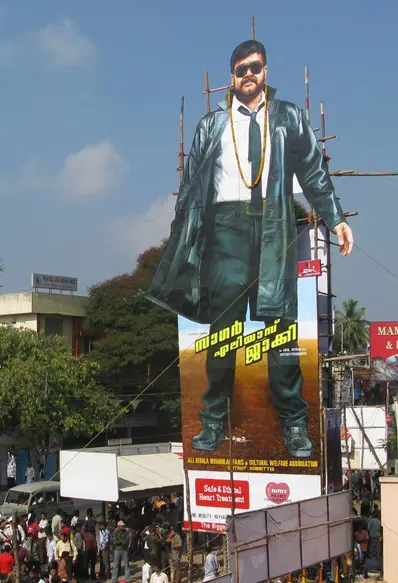
A Tradition Painted on Wood, Steel, and Time
Long before digital printing changed the face of outdoor advertising, Kerala developed its own visual language for celebrating the things it loved most — cinema, politics, and community. At the intersection of all three stood the cutout: a hand-painted, larger-than-life wooden or iron structure that announced the arrival of a star, a film, or a political figure with a declaration that could be seen from the end of the street.
These are not simply oversized paintings. They are structural objects — fabricated, painted, assembled, and installed through a process that can take an entire team several weeks to complete. Understanding how a cutout is made is to understand a form of craft that has no real parallel anywhere else in India.
It Starts With a Reference Image and a Grid
Every cutout begins with a source photograph — typically a publicity still from a film production, a posed portrait, or a frame captured during a major event. The artist's first task is not to pick up a brush. It is to study the reference image closely enough to understand how light falls across the subject's face, which features are most distinctive, and what the visual hierarchy of the composition should be.
The image is then divided using a grid system — the same technique used by Renaissance fresco painters to scale small drawings onto large walls. A small grid is drawn over the reference photograph, and a proportionally expanded version is marked out on the wood or sheet metal panels that will form the cutout surface. Each cell of the grid becomes a manageable painting area, allowing the artist to translate the composition accurately at a scale that would otherwise be impossible to judge by eye.
For large cutouts — some of which reach 40 to 60 feet in height for major film releases — this grid planning phase alone can take a full day of careful measurement and chalk marking before any paint is mixed.
The Materials: Built to Hold Up on a Kerala Street
The physical construction of a cutout is as much a carpentry and metalwork challenge as it is a painting one. Kerala's climate — high humidity, heavy monsoon rains, and intense coastal heat — demands materials that can withstand real environmental stress over the weeks or months the structure will stand.
The painting surface is typically 12mm or 18mm marine plywood, chosen for its resistance to moisture. Behind it sits a welded iron armature — rods and angle sections that hold the panels in position and anchor the structure to the ground. The paint is weather-grade enamel or acrylic, selected to resist UV fading and monsoon moisture over extended display periods.
The panels are cut to shape — not just rectangles, but complex silhouetted outlines that follow the form of the subject's hair, shoulders, and characteristic poses. This silhouetting is done by hand using jigsaws and angle grinders, and it is what gives Kerala cutouts their distinctive sculptural quality compared to flat rectangular billboards.
The Painting: Working in Sections You Cannot See Whole
Here is the central challenge of cutout painting that separates experienced artists from novices. When you are painting a face that will stand 40 feet tall, you are painting individual panels that may be 4 feet wide and 6 feet tall — sections of a cheek, an eye, a strand of hair. You cannot step back far enough to see the full portrait. You are working from the grid, from memory of the reference, and from an internalised understanding of how the colours and brushstrokes at close range will read at a distance.
Experienced Kerala cutout artists develop a specific visual intelligence for this — the ability to paint a brushstroke that looks rough and exaggerated at arm's length, knowing that from 30 feet away it will read as a smooth shadow under a jawline. It is the opposite of the way most painting is taught, and it takes years of practice to develop.
The eyes are always painted last, and are treated with particular care. A portrait's entire sense of life depends on the eyes landing correctly. On a large cutout, each eye may be painted on a separate panel measuring three feet across. The artist must ensure that both eyes — painted on separate surfaces, often by different people in a large workshop — carry the same tonal weight, the same highlight placement, and ultimately read as a single gaze when the panels are assembled.
The Six Stages of Production
Stage one is reference collection and composition planning. High-resolution photographs are gathered. The composition is decided — how much of the figure to include, what background treatment to use, whether the cutout will have a shaped silhouette or a rectangular border. Dimensions are agreed upon based on the installation site.
Stage two is structural fabrication. The iron framework is welded to the required dimensions. Plywood panels are cut to shape and fixed to the frame. Shaped silhouette edges are cut with power tools and sanded smooth. The structure is primed with a base coat to seal the wood against moisture.
Stage three is grid layout and pencil sketch. The proportional grid is chalked or pencilled onto the primed surface. Key lines — face outline, eyes, nose, hairline — are sketched in lightly to establish the composition at scale. This stage is corrected and refined before any paint is applied.
Stage four is base colour blocking. Large areas of flat colour are applied first — sky, background, clothing, skin tone base. This establishes the overall tonal structure of the piece and allows the artist to check proportions against the reference before committing to detail work.
Stage five is detail painting and modelling. Shadows, highlights, facial features, and fine details are added layer by layer. Hair is typically one of the most time-consuming elements — each lock is suggested with careful brushwork that reads naturalistically from a distance. Text elements, logos, and film title lettering are added at this stage.
Stage six is finishing, varnishing, and installation. A protective varnish coat is applied over the completed painting. The structure is then transported to the installation site — often in the early hours of the morning to avoid traffic — and erected using cranes or scaffolding. Final touch-ups are made on-site after installation.
The Artists Behind the Work
Kerala's cutout artists occupy a unique position in the creative ecosystem. They are not gallery painters or commercial illustrators — they are specialist craftspeople who learned their trade through apprenticeship, often starting as teenagers mixing paint and cutting panels in a workshop before being trusted with the work of painting a face.
The most accomplished artists are known by name in Kerala's film and political circles. They have a reputation that travels through fan club networks, and demand for their work peaks around major film releases — when the pressure to have the cutout ready for the first day, first show is absolute and non-negotiable.
What they do is physically demanding, technically precise, and deeply tied to the culture it serves. It is a form of art that exists not in galleries but on street corners — painted for a specific moment, for a specific audience, and displayed with a pride that is entirely its own.