
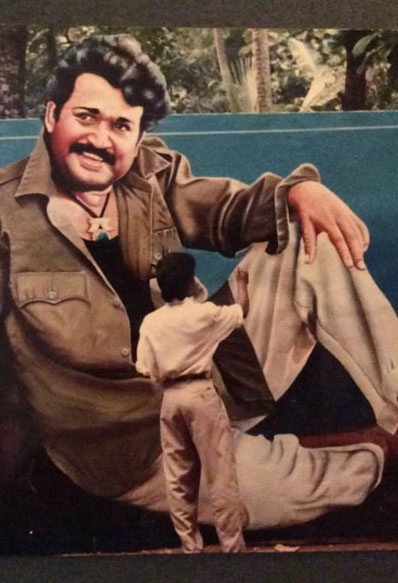
Long before digital screens defined our skylines, one self-taught artist from Neyyattinkara was making legends larger than life — one hand-painted cutout at a time.
In a Kerala still discovering its love for cinema, a young man named James quietly picked up a brush and began to paint faces on walls. Not just any faces — the faces of gods, of champions, of dreamers. Faces that measured 20 feet tall, that watched over street corners and theatre facades, that made entire neighbourhoods stop and stare. James had no formal training. He had something far rarer: an instinct for likeness, a steadiness of hand, and an obsession with getting it right.
The people who passed by those early hoardings didn't know his name. But they felt his work. They recognised something true in the curve of a cheekbone, in the set of a jaw, in the glimmer he captured in a painted eye. In time, the name they would come to know was not James — but Silpi. A pseudonym that means sculptor. A name that fit.
Through the early 1990s, Silpi's portraits became fixtures of South Kerala's visual landscape. Working from Neyyattinkara, he crafted hand-painted cutouts and hoardings for Malayalam cinema — the medium through which an entire generation experienced its heroes. His canvases were not stretched linen but the open sky. His gallery was every road that led to a theatre.
The names that appeared under his brush read like a roll call of an era:
- Mohanlal
- Mammootty
- Shah Rukh Khan
- Sachin Tendulkar
Each portrait was an act of devotion — to the subject, to the craft, and to the audiences who gathered beneath them. Fan associations commissioned his work. Cinema halls waited for his finishing touch before their opening nights. Silpi was not decorating walls. He was shaping how an entire region saw its icons.
Every stroke of paint carried emotion and energy. The streets were the gallery, and the people were the audience — passing by, looking up, recognising something of themselves in those larger-than-life faces.' — Silpi (James), Founder, Silpi Advertising
But the 1990s gave way to the 2000s, and with them came the printers. Digital technology transformed the outdoor advertising industry with breathtaking speed. What once took an artist weeks of painstaking brushwork could now be produced in hours. For many hand-painters, this was the end. For Silpi, it was a pivot.
Rather than resist the change, he embraced it — bringing the same eye for craft and visual storytelling that had defined his painted work into the new world of large-format digital printing and professional outdoor media. In 2009, this evolution took a landmark form: the launch of Mega Print, inaugurated by none other than Mohanlal himself — a full-circle moment for an artist who had spent years painting the superstar's face across Kerala's skylines.
Then came 2016. And with it, a reminder that some gifts cannot be automated.
Silpi returned to his roots — brush in hand, paints laid out — and created a cutout of Mohanlal from the blockbuster Pulimurugan. The image spread across social media with the velocity of a new kind of word-of-mouth. An old craft finding a new audience. A portrait that proved, in an age of pixels and printers, that the human hand still speaks a language no machine has fully learned.
Today, Silpi Advertising is much more than one man and one brush. It is a full-service Out-of-Home (OOH) and branding solutions company — with hoarding networks, signage systems, and integrated brand display services spanning South Kerala and beyond. Since 2023, the company has entered a new phase of structured growth, scaling its operations while staying rooted in the principles that built its reputation: precision, craft, and a genuine love for the visual.
But within all of that growth, James — Silpi — remains the most celebrated name. Not for spreadsheets or strategies, but for what his hands have always known how to do: capture a face, a feeling, a moment, and hold it still long enough for the world to see.
Portrait cutouts, in their truest form, are an act of translation. They take the private image of a beloved person — a film hero, a cricket legend, a cultural icon — and render it in the shared language of public space. They say: this person matters here, in this neighbourhood, to these people. Silpi understood that. He understood it before anyone called it brand communication. He simply called it painting.
Three decades on, that understanding is what sets Silpi Advertising apart — not as a company that survived change, but as one that was built by someone who always knew what endures: the human face, faithfully rendered, on a wall where everyone can see.