
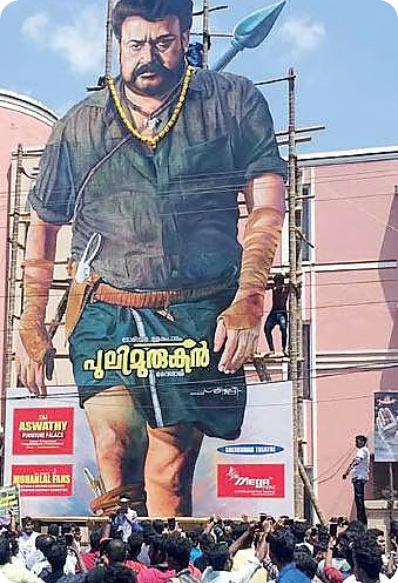
It is 4 AM outside a theatre in Trivandrum. A film is releasing in six hours. A group of thirty men — most of them in their twenties, wearing matching printed T-shirts bearing the face of the actor they are about to celebrate — are erecting a painted wooden cutout on a bamboo and iron scaffolding structure. Flower garlands are already being threaded. Firecrackers are waiting. The cutout, 35 feet tall and hand-painted over three weeks by an artist in a workshop in Kazhakuttam, is going up.
This scene repeats, in some form, in virtually every town in Kerala on every major film release. It is one of the most distinctive cultural rituals in Indian cinema. And despite everything that has changed in the last two decades — multiplex culture, OTT platforms, social media fandoms — the cutout has not gone anywhere.
Why a Painted Portrait Carries More Weight Than a Printed One
This is the question at the centre of understanding Kerala's cutout culture. In an age when photorealistic large-format printing is cheap and fast — when any image can be reproduced at any scale in a few hours — why do fan clubs continue to commission hand-painted cutouts that take weeks to produce and cost significantly more? The answer has nothing to do with the image. It has everything to do with the act.
A hand-painted cutout represents labour performed in devotion. Every brushstroke on that surface was made by a human hand, in service of a celebration. When a fan club commissions a cutout, they are not purchasing a reproduction of their hero's face — they are funding a ritual object, something made for this occasion, for this release, for this community. The handmade quality is not a limitation of the medium. It is the entire point.
A flex print is fast, precise, and affordable. It can be ready in hours and replicated at any quantity. But it carries no evidence of the human effort behind it — and for fan culture, that absence matters. A hand-painted cutout is slow, personal, and singular. Each one is a one-of-a-kind object carrying the marks of its maker. The imperfections are not flaws. They are evidence of the devotion behind the work.
The Fan Club as Patron
Kerala's film fan clubs function as surprisingly sophisticated organisations. The major ones — particularly those aligned with stars of the magnitude of Mohanlal, Mammootty, or the younger generation of leading actors — have district and panchayat-level chapters, annual general meetings, charitable activities, and substantial funds raised from members across the year.
When a major film is announced, the state-level fan club coordinating body will circulate guidelines to local chapters about how the release should be celebrated. The cutout — along with theatre decorations, milk and pongala offerings, and the all-important first-day crowd — is central to this coordination.
Commissioning a cutout is a matter of status among fan clubs. The scale, the quality of the painting, and the strategic prominence of the installation location all communicate the seriousness and resources of the chapter behind it. A major hand-painted cutout for a high-profile release can cost between ₹50,000 and ₹3,00,000 depending on scale and the reputation of the artist. This cost is borne entirely by the fan club — not the production house or distributor. It is a gift, freely given, to mark an occasion the community considers worthy of celebration.
The Five Rituals of a Cutout Release
The cutout is not simply erected and left to stand. Around it has developed a full ceremonial vocabulary that defines how a film release is experienced in Kerala's fan communities.
The first is the unveiling. The cutout is covered with a cloth and revealed publicly, often the night before the release, accompanied by music, firecrackers, and milk or rose water poured over the structure. The unveiling is photographed extensively and shared across WhatsApp groups and social media within minutes.
The second is the garland offering. Flower garlands — often in the actor's preferred colours or the film's colour palette — are draped over the cutout. In major releases, the weight of the garlands can be a deliberate statement; some fan clubs commission garlands measured by the kilogram as a display of reverence and resources.
The third is the first show procession. Before the first screening, a procession from the cutout installation to the theatre entrance is a common tradition in many towns. This physically connects the outdoor monument to the moment of cinema — the street and the screen become continuous spaces of celebration.
The fourth is the social media circuit. Photographs of the cutout are shared exhaustively across fan networks before the film even begins. Ironically, the most physically located object in the celebration — the cutout rooted to its corner — becomes the most digitally mobile image of the release weekend.
The fifth is its role as a community gathering point. For the duration of the film's theatrical run, the cutout serves as a meeting point for fans, a backdrop for photographs, and a declaration to the neighbourhood that a cultural event of significance is under way. Its presence changes the character of its street.
What Brands Can Learn from Fan Culture
There is something that outdoor advertising practitioners can learn from the way Kerala's fan clubs deploy cutouts. The most effective advertising does not just display a message — it creates an event. It gives a community a reason to gather around it, photograph it, and share it.
The cutout achieves this through scale, craft, and cultural specificity. It is impossible to ignore because it is enormous. It commands respect because it was clearly made by hand with considerable effort. And it resonates because it is speaking directly to a community, in a visual language that community has developed over generations.
For commercial advertising, the lessons translate directly: scale commands attention, craft signals value, and cultural specificity earns trust. These are not principles that expire with changing technology.
The hand-painted cutout endures not despite modernisation, but because modernisation has made its qualities rarer and therefore more meaningful. In a world saturated with mechanically reproduced images, something made by hand is not anachronistic. It is remarkable.